Medical Training and Medical School FAQ – Answered by a Doctor
What exactly does it take to become a doctor? What does medical training involve?These are questions that a lot of people have. This page is designed to help answer some common questions about medical training.

Photo courtesy of Lisa Brewster
How long is medical school?
Medical school itself is four years long. However, it takes quite
a bit longer than that to become a doctor. First you must get your undergraduate degree from a college. Many people ask the question does it matter what major I choose as a premed? The short answer to this is no, but you can find my answer to this question here. You do need to make sure you fulfill the medical school requirements, and you can find out more about these requirements here.
After your undergraduate degree, you will apply for medical school. This is a long process and part of the answer to “how long is medical school?” For more about the medical school application, click here.
Once you have applied to medical school, you are ready to begin your medical training. As stated before, the short answer to “how long is medical school?” is four years. You will have a medical degree at the end of your four years. The medical program consists of two years of classwork and two years of clinical work.
For a more complete answer to this question, click here.
Which Premed Major Should I Choose for Medical Training?
The short answer to this question is: it doesn’t matter much. As long as you meet the medical school admissions requirements during your time in college, you’ll be in good shape.
For a full discussion on this and my recommended classes, click here.
What’s in the medical school curriculum?
The first two years you will be studying just like you were in premed. Your medical training will likely be more intense than your undergrad, however. You will cover a lot of material in a short amount of time. This is the time when you will likely be repeating your question “how long is medical school?” Keep going! It gets better.
In these two years, the medical school curriculum consists of many different subjects. Subjects taught in medical school include anatomy, physiology and histology. Anatomy is the study of the human body. Physiology is the study of how the human body works. Histology is another of the subjects taught in medical school and deals with the study of human tissues under the microscope. I would suggest taking all of these as a premed to make your medical school curriculum easier!

After your first two years you will take the USMLE Step 1. This is a difficult test but an important part of your medical training and necessary to get your medical license. You can find the books I recommend for USMLE here.
Now that you’ve passed USMLE step 1, you can breathe again! It’s time to start your clinical years. These years are the ones that really teach you to be a doctor. It’s what you signed up for when you decided to go to medical school! You’ll be treating patients, working in the hospital. Third year you will have several required rotations, including surgery, pediatrics, OB/GYN, internal medicine, psychiatry, neurology, family medicine and ambulatory medicine. You’ll be working 6 days a week most of the time and over 12 hours a day. It’s intense, but this is where you earn your medical degree! You’ll learn to take care of patients in real life. You get to apply what you’ve learned in the medical school curriculum and see how the subjects taught in medical school really work. It’s exciting! At points you will again be asking “how long is medical school!?!?,” but overall you will love it.
Fourth year is a nice, relaxing year. You get to choose your electives and there is a lot less pressure. This is true except for subinternships, which is where you are trying to impress people in the field of your choice and maybe get a letter of recommendation.
You’ll also be interviewing for medical residency during this time.
For more detail on the medical school curriculum, click here.
What is medical residency?
As opposed to medical school, medical residency is a time when you will train in your specialty of choice. There are many residencies to choose from. Anything from psychiatry to orthopaedic surgery to pediatrics to internal medicine. If you are interested in going into something like cardiology or endocrinology, you will first do medical residency in internal medicine.
Your choice of residency definitely will impact the answer to the question “how long is medical school” and “how long is medical training?” For a specialty like family medicine, your residency will be three years. For a specialty like neurosurgery, your residency will be seven years or more! For details about specific residencies, click here. You can select a specialty from the top right corner. Some specialties are much more competitive than others, making them a difficult medical school match.
What is the medical school match?
The medical school match is the process by which a medical student enters medical residency. Residency is where your specific medical training begins. You choose which specialties to apply to and at which programs across the country. You fill out an application on ERAS (electronic residency application service) which is similar to the medical school application. You still have to write a personal statement. Follow the same rules as the medical school personal statement.
You then go to interviews at the schools where you would like to make the medical school match. These are also similar to medical school interviews.
You then enter your “rank list” of the schools where you would like to attend medical residency for your medical training. This is done through the NRMP or National Resident Matching Program. The schools also make a rank list of the applicants that applied to your school. If you ranked them highly and they ranked you highly, a medical school
match has been made and you are on your way to medical residency!
The medical school match is built for medical students, really. You should put your top choice as where you want to go most. Sometimes people don’t do this and end up unhappy. It’s really pretty simple. Put your list in the order of where you want to train. Period.
What are good medical school graduation gifts?
Obviously this will depend on the person, but I have a few ideas that I share here.
Put a former UCLA medical school admissions committee member on your side!
During my time on the UCLA medical school admissions committee, I learned exactly what it takes to get into a top medical school. I’ve compiled that information into my eBook:
10 Steps to Accepted: An Insider’s Guide to Getting Into Medical School
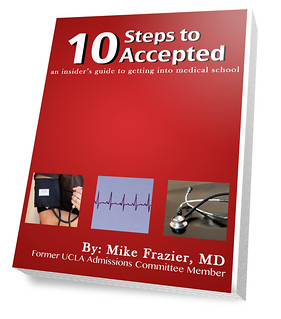


Here you’ll find essential and easy-to-understand information about applying to medical school. You’ll learn the exact categories medical schools look at and how to stand out in each. You’ll also learn the relative importance of those different categories. Most importantly, you’ll be able to see things from the insider perspective of a medical school admissions committee member. Click here to find out more!
If you’re looking for something that’s more than a book, but less expensive than 1 on 1 advising and editing services, check out my new members only site, Medical School Inside Track.

-
Videos describing the entire admissions process, from choosing to apply to choosing
between multiple acceptances -
A custom tool to know your chances based on MCAT, GPA and race
-
A custom tool to know exactly where to apply based on MCAT, GPA and state of residence
-
Examples from successful applicants of AMCAS activities, personal statements,
secondary essays, descriptions of hardship and descriptions of disciplinary actions -
4 hours of recorded interview prep to learn what it takes to ace an interview
And much more! All for less than the cost of 1 hour of one on one advising. You can check it out here.
You may even be looking for professional help to help you reach your goal of getting into your best medical school. There are many companies out there that promise to help you do this, but I recommend MedSchoolCoach. MedSchoolCoach is run by people who have been on medical school admissions committees. They know what it takes for you to get into your top ten medical schools. Plus, they have a great track record of success. You can check out their products here.

Summary
So, medical training is a long process. Some people will be in one medical program or another for 11 years. Crazy! But, if it’s something you love, it’s worth it. Plus, don’t you want a person with a medical degree and a medical license to have plenty of experience? This training is how that happens.
What Other Visitors Have Said
Click below to see contributions from other visitors to this page…
Community College Classes
I know there is a similar question about this already, but I was wondering, what would med schools tolerate in relation to taking required courses in a …
Had terrible grades in the past and in a low math course.
I am in a terribly low math course at my local city college(pre- algebra) and in high school, I never took a math class higher than Geometry. When I was …
What’s the best route to get into medical school?
I’m in high school and considering a career in medicine. I didn’t get the best grades my freshman year. Will that be a problem to get into medical school? …
What are the requirements for in state tuition for medical school?
I am from Tennessee and I want to get an associates degree here. After that, I want to get my bachelor’s degree and go to med school in another state. …
Do you start medical school right after high school?
I’m not too clear on the process of medical school. Do you go to college and study something like biology, then go to medical school? How does the process …
How will it affect me if I take a year off during medical school?
I am planning on taking a year off during or after medical school. I might pursue a church mission, a Master’s degree or something else. I’m just not sure …
Is it a problem for me to delay my medical school application until my senior year?
I am planning on taking a year off between college and medical school. Will this affect how my application is viewed?
Is becoming a sonographer a good idea for applying for medical school?
I’m looking to apply to medical school in the future and I am considering what would be a useful bachelor’s degree. In my research, I have found that it …
Will one year of bad grades make it so I won’t get into medical school?
I am a freshmen in college. I haven’t gotten the best grades this year and I’m considering what will be my next step after graduation in case I don’t get …
If I take one science class at a community college will I not get into medical school?
I want to take a few credits over the summer so I can transfer into a university. None of the colleges near me offer the class I need during summer so …
What do you learn in medical school?
I’m interested in psychiatry and wanted to know what kinds of things you study in medical school.
Can I attend the medical school of my choice if I join the Navy?
On the Navy’s website it says they’ll pay for tuition fees in full for medical school, but it’s not clear whether I can attend a medical school of my choice. …
Where should I volunteer to increase my chances of getting into a medical school?
I want to get into a medical school like Stanford or Harvard. I haven’t volunteered before. I have no experience volunteering. I want to start now to maximize …
Do Medical schools care about what undergraduate school you went to?
If I’m trying to decide between two different colleges, does it matter which one I choose if I want to go to medical school?